Compact wire path
The reference layout uses six guide wheels, reducing the number of wire-contact points and supporting straightforward maintenance.
Precision cutting for advanced materials
A controlled slicing platform for silicon, silicon carbide, sapphire and other hard-brittle materials. Built around a compact wire web, closed-loop tension management and a process-first approach to qualification.
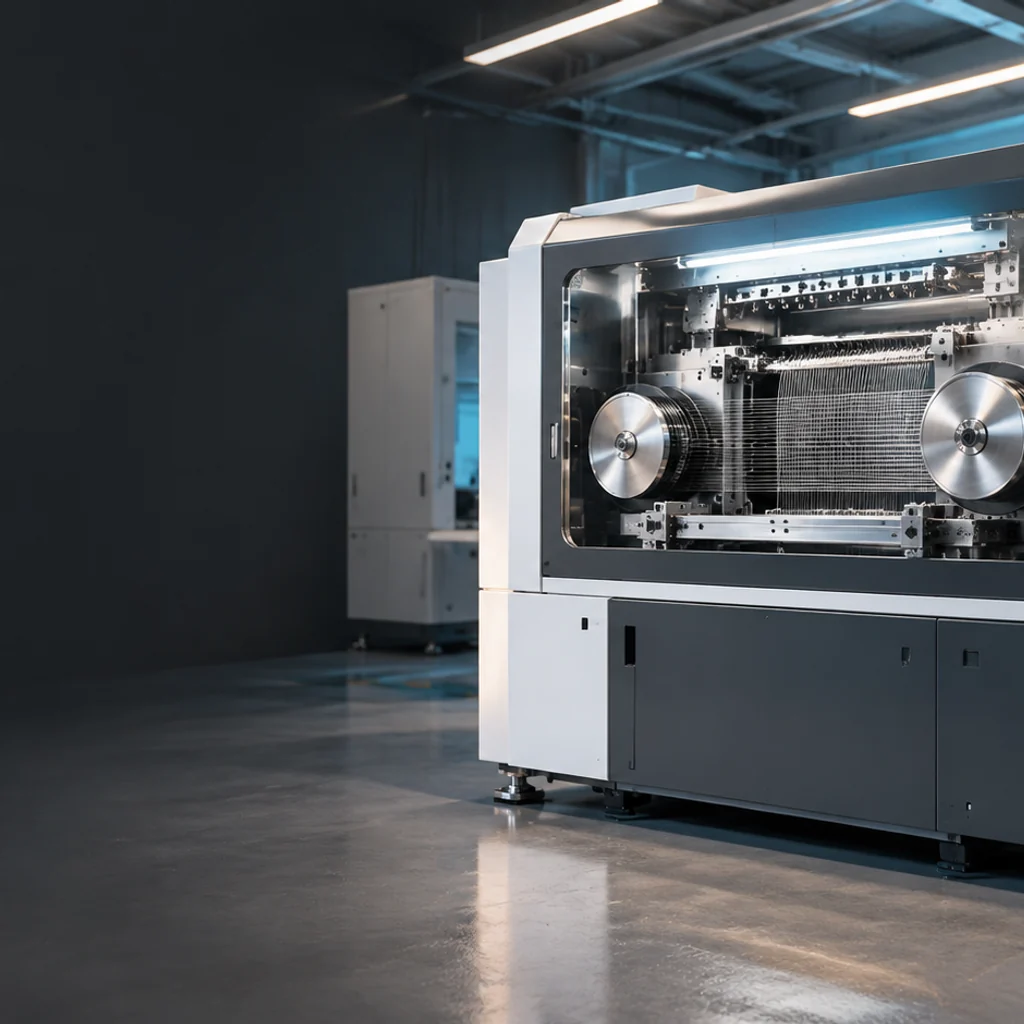
Original conceptual equipment visualization.
Not a customer installation.
Values from the supplied JY360 reference document. Final scope, performance and acceptance criteria are subject to material validation and written confirmation.
Company profile
Shanghai Xinkehui New Materials CO., Ltd. is a semiconductor materials solutions supplier working with customers on wafers, substrates, engineered glass and related process requirements.
Established in 2020, the company’s public profile describes two production bases and a Shanghai commercial center, alongside a broad supplier network. That materials perspective helps us frame equipment conversations around substrate condition, target geometry, yield and the downstream process - not simply a machine specification.
Material, sample geometry and acceptance targets are reviewed before a configuration is proposed.
Wire management, coolant control and thermal stability are considered as one cutting system.
Commercial and technical scope can include installation planning, training and after-sales support.
Product overview
A diamond-coated wire forms a parallel cutting web. The workpiece advances into the web under controlled feed while coolant, tension and guide-roller geometry work together to support repeatability.
Secure the workpiece and confirm orientation, datum and cutting position against the approved process sheet.
Thread diamond wire through the guide-roller grooves, then establish the agreed tension and wire direction.
Start coolant flow and advance the workpiece while monitoring wire tension, speed and system alerts.
Measure agreed outputs such as thickness, surface condition and geometry; adjust parameters only through controlled trials.
The reference layout uses six guide wheels, reducing the number of wire-contact points and supporting straightforward maintenance.
Closed-loop supply and take-up control is specified to support steady wire tension, with tension warning and break detection.
Independent coolant and bearing-oil cooling circuits are arranged to help manage heat in cutting and transmission zones.
Wire payout, take-up, traverse, spindle, tension and table feed use servo-driven control in the supplied reference configuration.
The brochure specifies an integrally cast cutting chamber with annealing, a dual-cone roller structure and locating shoulders for rigidity.
The reference machine brochure describes cloud monitoring and remote maintenance capability. Data policy and site access are to be confirmed.
Material applications
Use this as a screening guide. Every material and specification should be confirmed through sample review, agreed test methods and a controlled cutting trial.
Ingot, brick and sample slicing for semiconductor and research workflows.
Hard-brittle substrate cutting where wire, feed and coolant strategy require careful qualification.
Substrate, window and optical-material slicing with orientation and surface requirements reviewed.
Material-specific assessment for compound semiconductor ingots and qualified samples.
Laser-crystal and advanced-ceramic cutting evaluated against sample size and downstream finish.
Brittle specialty materials requiring fixture, coolant and process-condition review.
Not sure whether your material is suitable? Send the material type, dimensions, target thickness and quality criteria. We will identify what needs to be tested before a machine recommendation is made.
Start a material reviewApplication briefs
These are anonymous, illustrative application profiles - not customer testimonials or verified machine results. A final case report is issued only after agreed trials and measurements.
Define the cutting plan from sample geometry, target thickness, wire specification and the measurement method for surface and geometry.
Evaluate wire contact, feed strategy, coolant condition, kerf and heat management around the customer’s quality priorities.
Align the proposed cutting route with crystal orientation, downstream polishing allowance and the agreed inspection criteria.
Reference specifications
The table below reproduces the major values from the supplied reference document. It is a configuration reference, not a site-specific performance guarantee.
Download English specification
Diamond multi-wire saw
| Parameter | Reference value | Unit |
|---|---|---|
| Maximum workpiece envelope | 360 × 220 × 220 | mm |
| Roller coating dimensions (dual-cone) | Φ160 × 370, three axes | mm |
| Table vertical stroke | 250 | mm |
| Cutting speed | 400–1,200 | mm/h |
| Wire speed (maximum) | 1,200 | m/min |
| Diamond wire diameter | 0.10–0.50 | mm |
| Supply spool capacity | 20, at 0.25 mm wire | km |
| Cutting thickness range | 0.3–20 | mm |
| Roller slot accuracy | 0.01 | mm |
| Table verticality | 0.01 | mm |
| Swing angle | ±8 | ° |
| Lift-door stroke | 1,060 | mm |
| Total machine power | ≤40 | kW |
| Power supply | Three-phase four-wire, AC 380 / 50 | V / Hz |
| Main motors | 5.5 × 3 | kW |
| Payout / take-up motors | 5.5 × 2 | kW |
| Table lift motor | 0.4 × 1 | kW |
| Table swing motor | 1.3 × 1 | kW |
| Traverse motors | 0.4 × 2 | kW |
| Tension-control motors | 2.9 × 2 | kW |
| Lift-door motor | 0.75 × 1 | kW |
| Dimensions (dual-cone) | 2.5 × 2.0 × 2.8 | m |
| Dimensions with lift door open | 2.5 × 2.0 × 3.9 | m |
| Approximate machine weight | 4,880 | kg |
Specifications are transcribed from the supplied reference brochure and should be read as indicative. Voltage, plug, guarding, safety devices, consumables, control interface, site utilities, performance metrics, warranty and final accessories may vary by project and destination. Obtain written confirmation for the offered configuration. “To be confirmed” indicates information not established by the supplied source material.
Process comparison
Different wafering technologies suit different volumes, geometries and investment profiles. This comparison describes general process characteristics; the right choice depends on your product and validated economics.
| Decision factor | Multi-wire saw | Inner-diameter saw | Outer-diameter saw |
|---|---|---|---|
| Typical production role | Parallel multi-cut slicing | Single-wafer or low-volume slicing | R&D, sampling or coarse sectioning |
| Throughput potential | Multiple wafers per pass | One cut at a time | One cut at a time |
| Consumable system | Diamond wire + guide-roller wear | Specialty annular blade | Peripheral blade |
| Geometry constraints | Wire web and workpiece envelope define scope | Blade size and mounting define scope | Blade exposure and workholding define scope |
| Kerf economics | Wire diameter and pitch drive kerf | Blade thickness drives kerf | Blade thickness drives kerf |
| Process qualification need | Material-specific trial recommended | Material and blade-specific | Material and blade-specific |
No ranking is implied. Multi-wire processing can offer production advantages for suitable parts, while other methods may be preferable for specific low-volume, sample-preparation or geometry requirements.
Consumables & service parts
A wire saw is a system of wire, guides, motion, coolant and controls. A planned parts strategy helps protect process consistency and makes maintenance more predictable.
Ask for a parts reviewSpecification, coating and wire life should be matched to material and quality targets.
Groove condition influences wire position and cut stability; inspect against approved criteria.
Filter condition supports fluid cleanliness and stable debris removal in the cutting loop.
Replacement intervals depend on duty, lubrication and the final transmission design.
Keep coolant delivery consistent and check for wear or blockage during planned maintenance.
Wire spools and handling accessories must match the approved consumable and machine interface.
Part numbering and origin must be verified in the offered bill of materials.
No foundry-origin claim is made without supporting company evidence.
Inspection points and acceptance records are agreed before order.
Compare consumable life, uptime and maintenance with the purchase price.
Quality & delivery
The project structure below follows common industrial-equipment practice. Exact inspection documents, milestones, acceptance criteria and responsibilities are defined in the approved offer and contract.
Application review
Capture material, sample dimensions, target output, infrastructure, operator needs and time plan.
Technical proposal
Confirm reference configuration, options, interfaces and open items before commercial commitment.
Sample validation
Agree trial parameters, safe sample handling and measurement methods, then document the findings.
Build & inspection
Apply the project quality plan and define which functional, safety and documentation checks are required.
Delivery & installation
Coordinate packing, utilities, site access, installation responsibilities and commissioning acceptance.
Training & support
Establish operating procedures, maintenance routines, spare-parts planning and escalation channels.
Service & customer care
A productive wire-saw installation depends on careful preparation and a practical support plan. Shanghai Xinkehui can coordinate a project scope covering installation, operator training, process guidance and maintenance planning.
Site-readiness checks, installation coordination and commissioning scope to be agreed per project.
Training on safe operation, setup, process records and routine maintenance, based on the final configuration.
Inspection guidance, wear-part planning and response routes; intervals are to be established for your production duty.
The supplied brochure describes cloud monitoring and 24-hour service support. Territory, data access and SLA require written confirmation.
Factory or partner-facility visit availability, location and demonstration scope are to be confirmed before travel planning.
Build a recommended first-purchase parts list from the final BOM, duty cycle and local lead times.
Mineral-processing equipment
For non-semiconductor mineral projects, equipment selection starts with feed size, target fineness, capacity, moisture and product use. Availability and final specifications are to be confirmed.
Size reduction / primary
Useful where mined or reclaimed material must be reduced before milling. Selection depends on feed size, hardness and required discharge.
Select when: upstream size reduction is required.
Milling / versatile
A conventional option for many mineral grinding duties, with configuration influenced by throughput, target fineness and circuit design.
Select when: robust, flexible grinding is needed.
Milling / dry processing
Often considered for dry mineral powder preparation where the feed and target fineness align with the selected mill and classifier.
Select when: dry grinding and classification fit the product.
Classification / fineness
Used in suitable circuits to separate particles by size and support a controlled product cut point.
Select when: cut-point control is a key requirement.
These are adjacent mineral-processing options, not a claim that every item is manufactured by Shanghai Xinkehui. Models, capacities, testing, lead times and commercial availability are to be confirmed against the application.
Project resources
Use the clean English reference sheet for internal review. It contains the supplied JY360 reference values and highlights the items that need confirmation before a purchase decision.
Frequently asked questions
Final machine suitability depends on the material, geometry and quality requirement. Where a responsible answer depends on the project scope, we say so.
Ask a different questionMulti-wire saws are commonly evaluated for silicon, silicon carbide, sapphire, gallium arsenide, YAG, YSZ, technical ceramics and other hard-brittle materials. Material grade, crystal orientation, sample size and target surface quality must be reviewed before compatibility is confirmed.
A diamond-coated wire runs across a set of grooved guide rollers to form a wire web. As the workpiece is fed into the web, many parallel cuts are made at once. Coolant removes heat and carries away debris while closed-loop tension control supports process stability.
The supplied JY360 reference configuration lists a diamond wire diameter range of 0.10-0.50 mm. The suitable wire specification, coating and supplier must be confirmed for the actual material, kerf target and surface requirement.
The supplied reference configuration lists a cutting thickness range of 0.3-20 mm. This is an equipment reference range, not a guaranteed result for every material. TTV, bow, warp, surface finish and yield should be agreed through sample validation.
The JY360 reference configuration lists a maximum workpiece envelope of 360 x 220 x 220 mm (length x width x height). Please provide the actual ingot, brick or coupon dimensions because fixtures and process requirements can affect the usable envelope.
Cutting fluid controls process temperature and transports debris away from the cutting zone. The reference configuration uses an independent coolant chiller, plate heat exchanger and filter vessel. Filter grade, flow and maintenance interval must be matched to the material and site conditions.
The supplied reference configuration uses closed-loop tension feedback, with tension warning and wire-break alarm functions. Actual tension settings, alarm thresholds and safe recovery procedures must be established during process and safety validation.
Installation and commissioning support can be quoted with the equipment package. Scope, destination, site-readiness requirements, working hours and acceptance criteria are to be confirmed in the commercial agreement.
Operator training is available as part of a project-specific service package. The supplied brochure describes staff training support. Training format, duration, language and the number of participants are to be confirmed for each project.
Diamond wire, grooved guide rollers, wire guides, seals, coolant filters and selected bearings may require inspection or planned replacement. The exact wear-part list depends on the final configuration, material mix and production duty; verify part numbers before ordering.
Delivery lead time is to be confirmed after configuration, destination and inspection requirements are known. It is not possible to provide a responsible fixed lead time before the final technical and commercial scope is agreed.
A sample-cutting review can be discussed before purchase. Availability, sample quantity, safe handling, trial parameters, test methods and reporting scope must be agreed in advance. Results from one sample size do not automatically guarantee production-scale performance.
Start a conversation
Share the material, dimensions, target output and site conditions. We will use that information to frame the right technical questions and identify where confirmation or testing is required.